Field guide / Written translation

Documents across Languages

A translated document needs more than accurate sentences. It needs an agreed source, an identifiable audience, professional review and a reliable route to the person who will use it.

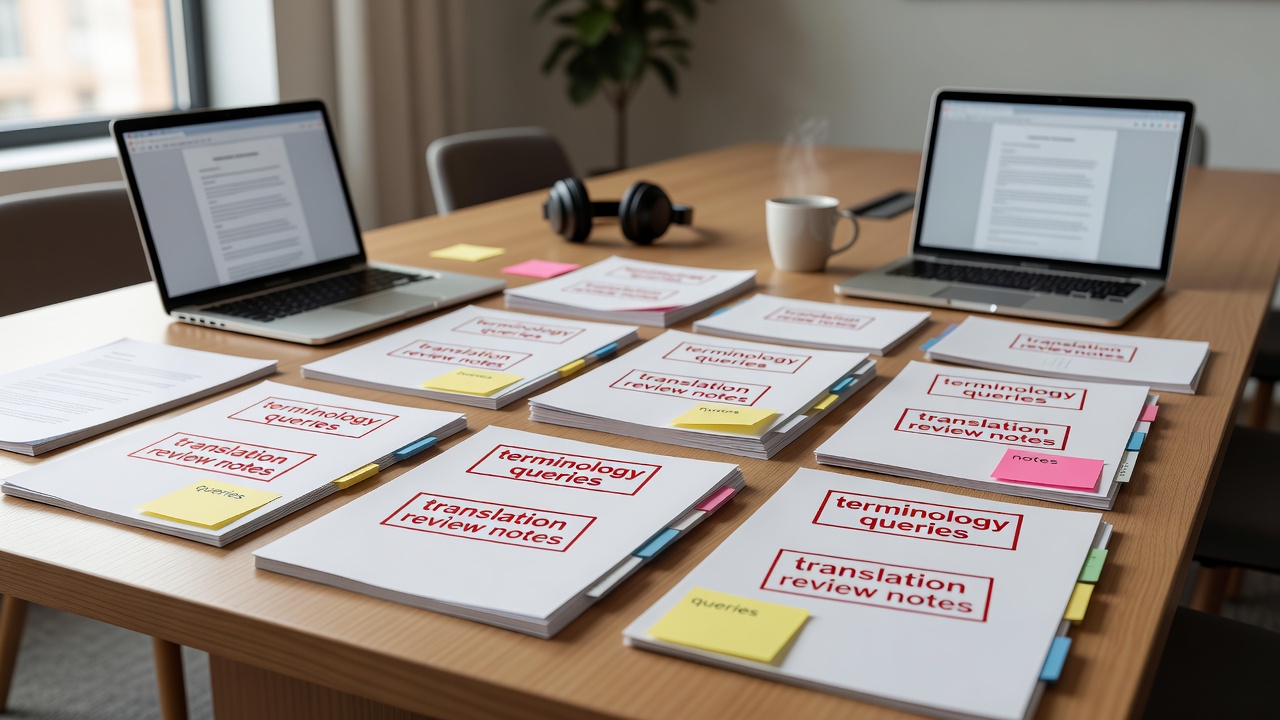
Event instructions marked with terminology queries and translation review notes
The document workflow begins before translation and ends after layout has been checked.
The pressure point

A perfect translation of yesterday’s instruction is still wrong for today

Give each document a source owner and a version. When the source changes, treat every affected language version as a managed update, not an attachment someone will remember to replace.

01 / Identify the reader

Start with the action the document supports

A team handbook, spectator notice, consent form and technical bulletin have different purposes. State who will read the document, where they will read it and what they need to do next. A short sign at an entrance cannot carry the same explanation as a downloadable guide, even if both concern accreditation.

Confirm the required languages and regional conventions with the audience or responsible organiser. Avoid treating a flag as a language label. Record the delivery format as well: editable document, accessible web page, print-ready file or subtitle text. Those choices affect preparation, review and layout, so they should not appear as a surprise after the translation is complete.

02 / Stabilise the source

Resolve ambiguity before it multiplies

Remove unexplained abbreviations, unclear pronouns and references such as “tomorrow” from instructions intended to travel. Use an explicit date and applicable time zone when needed. Confirm whether “registration” means entering the competition, collecting credentials or checking in at accommodation. The translator should not have to choose among different operational processes.

Provide editable source files rather than photographs of text wherever possible. Keep headings, tables and captions structurally clear. For a late source change, identify the changed passage and the current version instead of asking a provider to compare several almost identical files without guidance. Source ownership remains with the organiser throughout the process.

03 / Brief the professional

Explain terminology and risk

Share approved venue names, official competition terminology, existing reference material and terms that must remain unchanged. Keep personal names, booking references and access codes distinct from text that requires translation. Explain whether a document is operational guidance, public communication or content requiring specialist legal or medical expertise.

ISO 17100 addresses requirements for translation services, while ISO 18587 concerns full human post-editing of machine-translation output. Neither reference should be used as a decorative quality badge. Ask the provider to explain the actual workflow, qualifications and review included. Certified or sworn translation requirements depend on the receiving authority and jurisdiction; an event organiser cannot create them by adding a stamp.

04 / Review the meaning

Separate language checks from factual approval

A qualified language reviewer can assess accuracy, completeness and consistency. The event owner must still confirm facts such as dates, distances, addresses, eligibility rules and contact details. For regulated content, involve the authorised specialist. These checks complement one another; they are not substitutes.

Ask reviewers to record a reason for a proposed change and distinguish an error from a stylistic preference. Repeatedly rewriting an approved term can introduce inconsistency across documents. Keep queries visible until resolved, with one person responsible for accepting the final wording. Do not let several departmental copies silently develop into competing final versions.

05 / Check the delivered format

Read the layout, not only the text

Text expansion can hide a deadline in a table cell or push an essential instruction onto a second page. Check the formatted output in every language for missing text, correct reading order, meaningful headings and usable links. Review right-to-left layout where applicable rather than assuming that changing alignment solves it.

For digital information, WCAG 2.2 provides an important accessibility reference, but translation alone does not establish conformance. Supply text alternatives for meaningful images and avoid distributing essential instructions only as an image. Preserve readable type sizes and allow names and addresses to remain legible. A reader should not need to magnify a decorative layout to find the meeting point.

06 / Publish and maintain

Give every version a clear status

Record the source version, target language, approval status and publication owner. When an instruction changes, identify all locations where the old wording appears: website, printed pack, email attachment and venue notice. Retire obsolete versions where practical and make the effective version unmistakable.

Protect confidential material throughout the workflow. Do not paste personal or restricted event information into an unapproved translation tool. Confirm provider confidentiality, access and retention arrangements before transferring files. After the competition, retain or delete working material according to the agreed policy, and preserve useful approved terminology without retaining unnecessary participant data. The next event benefits from a clean glossary, not an uncontrolled archive.